
OLED vs. QLED for bright rooms: which TV is best?
Advertisements
QLED televisions are generally the better choice for bright living rooms because their dedicated backlight systems achieve significantly higher sustained peak brightness than traditional OLED panels, allowing them to overcome severe daytime glare and direct ambient sunlight. While OLED screens deliver unmatched contrast in dark environments, their lower full-screen brightness can make daytime viewing look washed out or difficult to see when windows are uncovered.
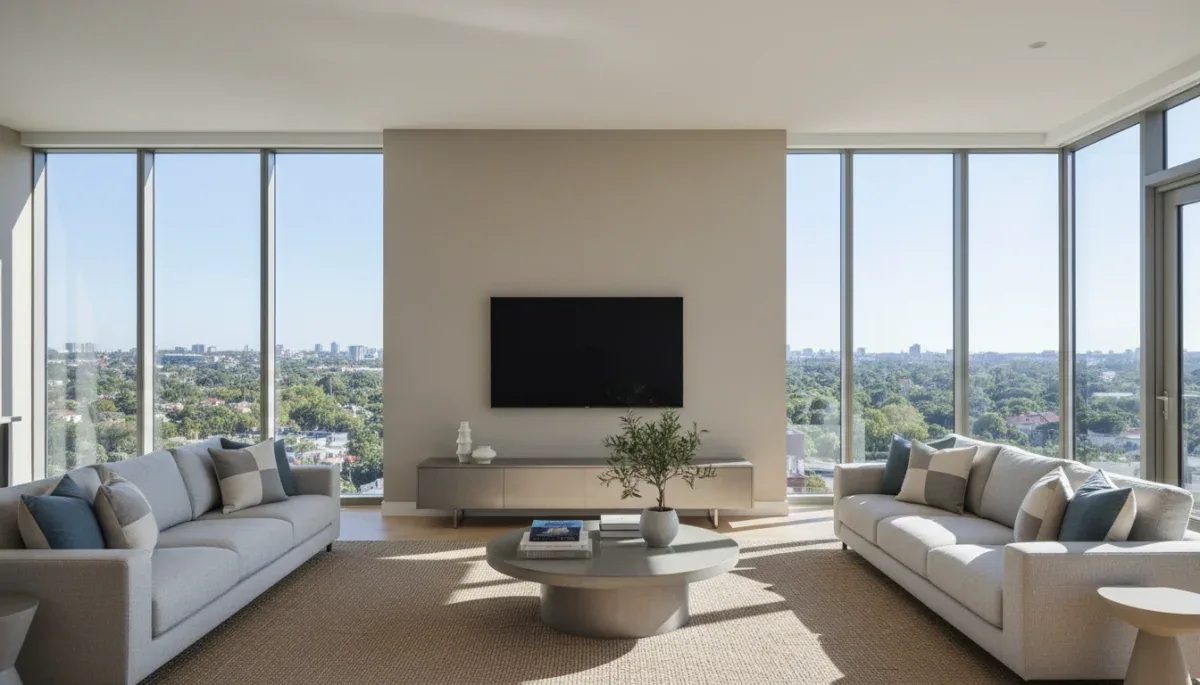
This comparison helps homeowners and apartment dwellers with south-facing windows, open floor plans, or overhead lighting choose the right display technology for their space. The trade-off is that while QLED handles intense daylight with ease, it relies on local dimming zones that can cause blooming around bright objects in dark scenes, whereas OLED delivers pixel-level precision at the cost of total luminous output.
How OLED and QLED create light and color
The core difference between OLED (Organic Light Emitting Diode) and QLED (Quantum Dot Light Emitting Diode) lies in how each technology produces illumination. OLED is a self-emissive technology, meaning every individual pixel produces its own light and color. When a pixel displays black, it turns off entirely, resulting in infinite contrast and zero light leakage into surrounding pixels.
Anúncios
In contrast, QLED televisions are transmissive displays. They use a traditional LED or Mini-LED backlight array positioned behind a liquid crystal layer, enhanced with a microscopic layer of quantum dots. These quantum dots convert blue light into highly saturated red and green wavelengths, allowing the display to produce a wider color gamut and higher luminance levels than standard LED panels.
Key architectural distinctions
- OLED panels use individual organic pixels that illuminate independently without a shared backlight.
- QLED panels rely on separate LED or Mini-LED backlights passing through a quantum dot enhancement film.
- QD-OLED hybrids combine blue OLED self-emissive substrates with quantum dot color converters to increase overall color brightness.
- Mini-LED QLEDs pack thousands of tiny diodes into hundreds of dimming zones for precise backlight control.
Peak brightness and daylight visibility
Peak brightness is the single most critical factor when evaluating a display for a sunlit room. Measured in nits (candelas per square meter), brightness determines whether a screen can cut through ambient illumination or if the picture will appear dim and lifeless during afternoon viewing.
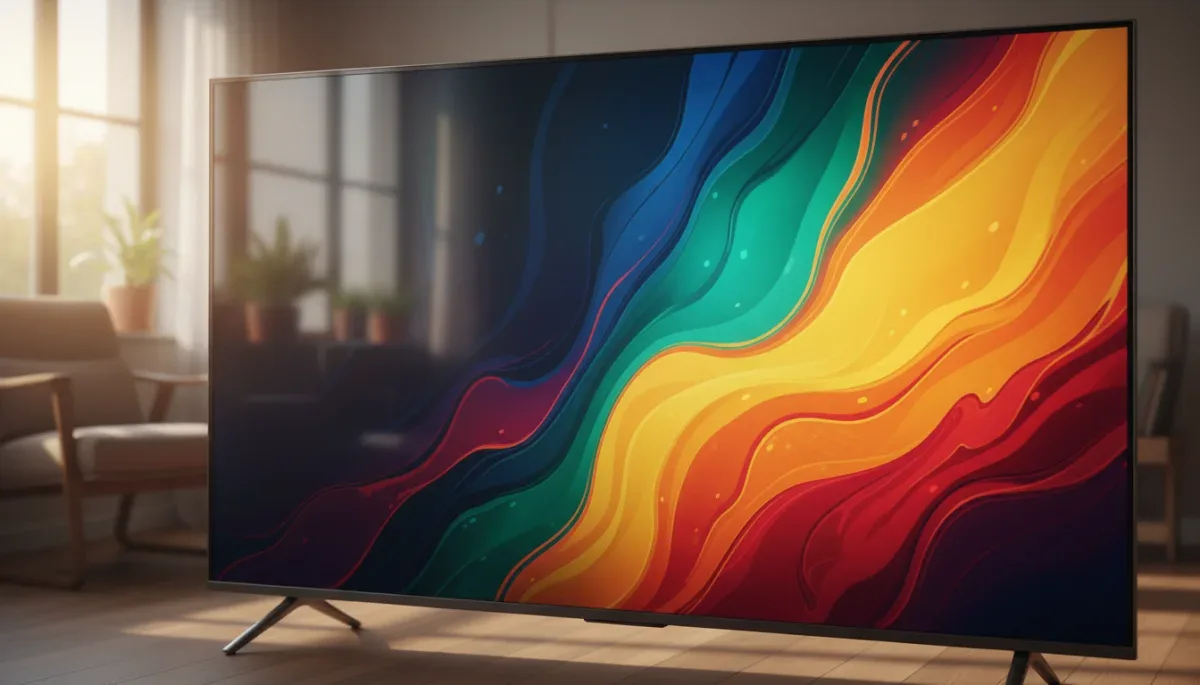
Premium QLED and Mini-LED sets routinely produce peak brightness levels between 1,500 and 3,000 nits on small highlights, and maintain 600 to 1,000 nits across an entire screen displaying bright content such as daytime sports or snowy landscapes. Standard OLED panels typically reach peak highlights between 800 and 1,300 nits, but their Automatic Brightness Limiter (ABL) reduces full-screen white scenes down to roughly 200 to 300 nits to prevent overheating and premature pixel degradation.
Anúncios
Because sunlight easily overpowers lower nit levels, a QLED panel maintains its punch, clarity, and visual impact throughout the brightest hours of the day without requiring you to draw the blinds.
Reflection handling and screen coatings
A bright room introduces two distinct types of light interference: direct reflections from light sources like lamps and windows, and diffuse ambient light that raises the perceived black level of the display. How a panel handles these reflections is just as important as its raw light output.
High-end QLED televisions frequently incorporate advanced anti-reflective optical layers that scatter or absorb incoming light, preventing sharp mirror reflections. Some modern lifestyle QLED displays even feature matte, anti-glare screen finishes that almost completely eliminate glare, though they slightly soften deep black levels in completely dark rooms.
OLED displays historically feature glossy glass surfaces that provide pristine clarity in dim environments but can act like mirrors when placed directly opposite an uncovered window. Newer OLED iterations utilize improved anti-reflective filters and micro-lens arrays (MLA) to reduce reflections, but direct rays of sunlight striking an OLED screen can still create noticeable purple or magenta tints on the panel surface.
Viewing angles across wide seating arrangements
Living rooms with abundant natural light often feature open layouts, deep sectionals, and multiple seating areas where viewers sit off-center from the television. Panel technology significantly affects picture quality when viewing the screen from an angle.
OLED holds a distinct advantage in viewing angles because its self-emissive pixels emit light in all directions equally. Viewers sitting far to the side experience virtually no loss in color saturation, brightness, or contrast. This makes OLED an excellent option for expansive living areas where people watch from dining tables or perimeter seating.
Most QLED televisions use Vertical Alignment (VA) LCD panels, which excel at blocking backlight for deeper blacks but suffer from severe color fading and contrast loss when viewed beyond 30 degrees off-center. Higher-end QLED models incorporate wide-angle optical layers to mitigate this issue, but they still struggle to match the uniform off-axis performance inherent to OLED technology.
Color volume and high dynamic range performance
Color volume measures a display's ability to render accurate, saturated colors across all luminance levels. In a bright environment, ambient light naturally desaturates colors on screen, requiring the television to pump out saturated hues at elevated brightness levels to maintain an accurate picture.
Why color volume matters in daylight
- Quantum dot efficiency enables QLED panels to maintain deep, vibrant reds and greens even at their highest nit outputs.
- Traditional WOLED displays add a white subpixel to boost peak brightness, which can dilute color saturation in very bright highlights.
- High Dynamic Range (HDR) formats like HDR10 and Dolby Vision require substantial brightness headroom to render sunlight, explosions, and specular glints realistically.
- Ambient light sensors built into modern sets dynamically adjust HDR tone mapping curves based on room lighting conditions.
Because QLED displays preserve color saturation at extremely high brightness, HDR content retains its intended impact even when your living room is flooded with natural daylight.
Long-term durability and direct sunlight exposure
When placing a television in a sun-drenched room, long-term panel durability is an important operational consideration. Direct ultraviolet (UV) radiation and concentrated heat from sunlight can impact electronic components and organic materials differently over extended periods.
OLED panels utilize organic compounds that are inherently more sensitive to ambient heat and direct UV exposure. Leaving an OLED television exposed to direct sunlight hitting the screen surface can accelerate pixel wear, degrade the anti-reflective layer, and potentially create permanent non-uniformity across the panel over several years of use.
QLED displays rely on inorganic quantum dots and robust LED backlights that exhibit significantly higher thermal stability and resistance to direct sunlight exposure. Furthermore, QLED technology carries zero risk of permanent image retention (burn-in), allowing users to keep bright news tickers, sports scoreboards, or video game interfaces on the screen for long durations without concern.
At a glance
| Factor | What to know |
|---|---|
| Peak brightness | QLED delivers substantially higher sustained brightness to cut through strong daytime ambient light. |
| Reflection handling | High-end QLED models feature superior anti-reflective coatings and matte options that disperse glare effectively. |
| Viewing angles | OLED maintains consistent color and contrast from any angle, whereas QLED degrades off-center. |
| Sunlight durability | QLED uses inorganic materials with no risk of burn-in or heat-induced pixel degradation from sunlight. |
Frequently asked questions
Can an OLED TV work in a bright room?
Yes, an OLED TV can work in a bright room if you control direct light with curtains or choose a newer model with high peak brightness and anti-reflective filters. However, standard OLEDs struggle if placed directly opposite large, uncovered windows where ambient glare overpowers darker scenes.
Why is QLED better for daytime sports viewing?
QLED is better for daytime sports because it maintains high full-screen brightness without aggressive automatic dimming. Uniformly bright playing fields, such as soccer pitches or hockey rinks, remain vivid and visible in sunlit rooms without losing luminance over extended viewing periods.
Does direct sunlight damage an OLED screen?
Yes, direct sunlight can damage an OLED screen over time. The concentrated heat and UV radiation from direct sun exposure can degrade the organic compounds in the panel, potentially causing permanent screen discoloration, panel non-uniformity, or damage to the anti-reflective coating.
Do newer QD-OLED TVs fix brightness issues in daylight?
Newer QD-OLED TVs improve color brightness and overall luminance compared to traditional WOLED panels, making them much more competitive in lit spaces. However, most QD-OLED panels lack a traditional polarizing layer, which can cause black levels to appear slightly raised or purplish under bright ambient light.
The bottom line
For living rooms with expansive windows, severe ambient daylight, and minimal light control, a high-end QLED or Mini-LED television remains the most practical and reliable choice. It provides the sustained luminance, color volume, and glare resistance needed to keep your favorite shows and sports crisp all day long. Before purchasing, verify your room layout to ensure your primary seats fall within the optimal viewing angles of your chosen panel.
Written by
Rita Luiza
Rita Luiza writes about news & benefits, fashion & beauty and tech & gadgets for newepisody.com. Each article explains how things work, compares published details such as prices, policies and program rules, and points readers to the official source before they decide.